A receipt for every task: what was done, what was checked
The idea
A receipt is the record that closes every Crewshal task. It says what was done, which checks ran and how they ended, how long the work took and what it cost (an estimate at list price, not an invoice). The platform seals it from records it already keeps, so the receipt shows exactly what was checked, and a later change to the work's output, checks or recorded activity marks it stale.
- The problem
- An AI agent's "done" is a claim; without a record you must trust it or check the work again yourself.
- Why it matters
- You read the output, the checks, the time and the cost in one place, and a check that could not run shows as not passed.
- Where it stands
- In production as of A production test task ended with a receipt that said Verified, 3 of 3; the worker checked its own work, and the run as a whole is recorded as partial.
Crewshal team · · 3 min read
Recorded run · Production, reserved test workspace · November 12, 2026
From one request to a sealed receipt
One request in production goes through triage, a start, three stage gates and a saved file, and ends with a receipt that says Verified.
PersonOne request
A person types one request in Flow and sends it: a saved Markdown checklist for a fictional bicycle repair shop, with exactly four steps in a set order.
InputThe request, as sent
Write a saved Markdown onboarding checklist for a fictional bicycle repair shop. Use only these four steps: receive the bike; record the requested repair; inspect the brakes; call the owner when it is ready. Include one heading and exactly four checkbox rows in that order. Keep the result under 120 words. Work within this task yourself. Do not hire, delegate, create child tasks, contact anyone, publish, connect accounts, run commands, or spend money.
PersonOne request
A person types one request in Flow and sends it: a saved Markdown checklist for a fictional bicycle repair shop, with exactly four steps in a set order.
The record for step 1
InputThe request, as sent
Write a saved Markdown onboarding checklist for a fictional bicycle repair shop. Use only these four steps: receive the bike; record the requested repair; inspect the brakes; call the owner when it is ready. Include one heading and exactly four checkbox rows in that order. Keep the result under 120 words. Work within this task yourself. Do not hire, delegate, create child tasks, contact anyone, publish, connect accounts, run commands, or spend money.
NovaNova sorts it, by rules
Nova, the workspace's chief executive, triages it by rules in 7 s: an idea, rank 57 of 100, for the roadmap. It waits there until a person starts it.
The record for step 2
DecisionNova's reason
No kind rule matched, so triage treats this as an idea. It ranks 57 of 100. It goes on the roadmap for next.
DecisionTriage
- Method
- Rules
- Time
- 7 s
- Rank
- 57 of 100
- Waits for
- A person to start it
PersonStart
The person presses Start. The work item AGT-4 opens in the plan stage, owned by Nova.
The record for step 3
InputStarted work
- Work item
- AGT-4
- Stage
- Plan
- Owner
- Nova
NovaPlan, build, check
Nova plans the work, builds the checklist and checks it. Each stage ends at a gate, and each gate records its owner, Nova, and its outcome.
The record for step 4
CheckStage gates
- Plan gate, owned by NovaPassed
- Build gate, owned by NovaPassed
- Verify gate, owned by NovaPassed
InputAcceptance criteria the plan wrote
- A saved Markdown document provides an onboarding checklist for a fictional bicycle repair shop.
- The body has one heading and exactly four checkbox rows: receive the bike; record the requested repair; inspect the brakes; call the owner when it is ready. The rows appear in that order, with no added steps.
- The complete body contains fewer than 120 words.
- The work stays within this task. It includes no hiring, delegation, child tasks, contact, publication, account connections, commands, or spending actions.
NovaA saved file, not a chat reply
The result is a saved document: revision 1, 178 bytes, with its content hash. It holds one heading and the four steps, in the asked order.
The record for step 5
OutputFictional Bicycle Repair Shop — Onboarding Checklist
# Fictional Bicycle Repair Shop Onboarding Checklist - [ ] Receive the bike. - [ ] Record the requested repair. - [ ] Inspect the brakes. - [ ] Call the owner when it is ready.OutputThe saved document
- Revision
- 1
- Size
- 178 bytes
- Content hash
- sha256 0d3030d761c3ff14
CrewshalDone, with a sealed receipt
The work moves to done, and in the same step the platform seals the receipt from its records: the output, the checks, the actions, the time and the cost. Its state is Verified: 3 of 3 recorded checks passed before completion. The receipt's own time, 1 min, runs from Start to completion. This replay counts from Send instead: the work was done about 1 min 50 s after Send. Nova checked the work itself: two checks are the platform's, and the third is an AI review in Nova's own run.
The record for step 6
CheckReceipt checks
- The saved revision is exact, and the requester can read itPassed
- The requirement parts, proven by the platformPassed
- An AI review of the saved content, in the worker's own runPassed
CheckWhat Verified covers here
Verified covers the receipt's 3 checks: two platform checks and one AI review in Nova's own run. The run's own required checks are separate: 3 failed and 4 did not run, so the run as a whole is recorded as partial.
OutputThe receipt in production
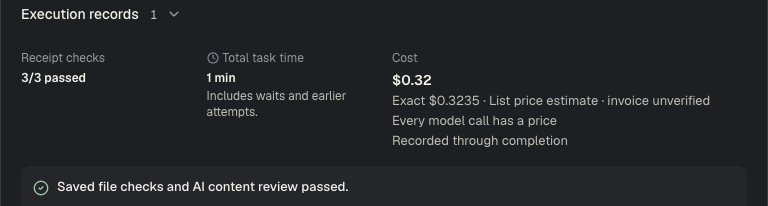
Execution record · Open full size OutputReceipt
- State
- Verified
- Checked by
- Nova, the worker itself, with platform checks; no other reviewer
- Time on the receipt
- 1 min; from Start to completion, including waits and earlier attempts
- Cost
- USD 0.32; exact USD 0.3235, an estimate at list price, not an invoice
- Receipt hash
- sha256 adb6d651f7f2a824
PersonDownload, reload, same bytes
The person downloads the file and reloads the page. The download has the same hash and size, and the same revision is still there after the reload: 2 min 1 s after Send. The script saw the work in the Shipped lane 2 min 15 s after Send.
The record for step 7
CheckDownload and reload
- The download is 178 bytes with the saved hashPassed
- The same revision is there after a reloadPassed
Result
Verified, 3 of 3, about 1 min 50 s after Send; the saved file then downloaded with the same hash.
- Send to done, receipt sealed
- about 1 min 50 s
- Send to the Shipped lane, as the script saw it
- 2 min 15 s
- Receipt checks
- 3 of 3
- Saved file
- 178 bytes, revision 1
Where it ran. Production at crewshal.com, in a reserved test workspace with one AI employee; a script played the person's clicks in a real browser. The run as a whole did not pass: three required checks failed (the request preview was slower than its 100 ms target, the first automatic reading of the request found no type and no acceptance criteria within 5 seconds, and the record does not tie every requirement to one exact check), and 4 more did not run. The record is marked partial; a complete pass of the whole request flow, and customer acceptance, are still open.
The recorded files behind this replay
- Production run record: gates F01 to F17 with times sha256 5732757656ca
- Acceptance record: what the run proved, and what stayed open sha256 0d78491d2d5f
- The saved checklist, as downloaded sha256 0d3030d761c3
- Production capture of the receipt sha256 6e9dffbdf483
Why it matters
"Done" from an AI agent is a claim. Without a record you must trust the claim, or check the work again yourself.
A receipt turns the claim into something you can read: the output, the checks and their results, the time and the cost. When a check could not run, the receipt says so instead of hiding it.
How it works
- The work saves real output. A document revision with its content hash, a file with its size and SHA-256, or a recorded action result such as a change or a message.
- The checks run on that output. The platform records each result and the exact output it checked. For Verified, each acceptance criterion of the plan must be covered by a passing check.
- The receipt is sealed. When the task moves to done, the platform collects the output, the checks, the actions, the time and the cost from those records, in the same step.
- The state says how far the proof goes. Verified needs real output, a passing platform completion check, current checks that all passed before completion, and coverage of every acceptance criterion in the current plan. A check that failed or could not run leaves the receipt Unverified, with the reason; it is not counted as a pass.
- It stays honest over time. When the output, the checks or the recorded activity change later, the receipt is marked stale. Earlier receipts stay as history.
What the run showed
The replay above is a production run on November 12, 2026, in a reserved test workspace with one AI employee. A script played the person's clicks in a real browser.
- The request asked for a saved Markdown checklist for a fictional bicycle repair shop, with exactly four steps in a set order.
- Nova, the workspace's chief executive, triaged it by rules in 7 seconds: an idea, rank 57 of 100, held for a person to start.
- After Start, Nova planned, built and checked the work. Each stage ended at a gate with Nova as its recorded owner.
- The saved checklist was revision 1, 178 bytes, with one heading and the four steps in order.
- The task was done and its receipt sealed about 1 minute 50 seconds after Send. The receipt said Verified: 3 of 3 recorded checks passed before completion.
- Nova checked the work itself. Two checks were the platform's: the exact saved revision and the requirement parts. The third was an AI review of the content in Nova's own run. No other reviewer and no person checked it.
- The download then had the same hash and size, and the same revision was still there after a reload, 2 minutes 1 second after Send.
Limits
- A test workspace. The run used a reserved production workspace and a scripted person, not an outside customer.
- The run as a whole did not pass. Three required checks failed: the request preview was slower than its 100 ms target, the first extraction found no kind and no acceptance criteria within its 5-second window, and the record does not bind every requirement to one exact check. Four more required checks did not run. The record is marked partial, and the whole Flow remains open.
- Self-checked. In this run the worker checked its own work; no independent reviewer took part.
- A receipt proves the recorded checks. It does not prove that a person approved the work or that a customer accepted it.
Frequently asked questions
What does "Verified" mean on a receipt?
The work saved real output, the platform's completion check passed, every check passed before completion, and every acceptance criterion of the current plan is covered by a passing check: a file check, a platform requirement proof or an AI content review. It does not mean that a person approved the work. Anything less shows as Unverified, with the reason.
Is a receipt a chat message from the AI?
No. The platform builds it from its own records of the output, the checks and the actions. The AI worker does not write it.
What happens to a receipt when the work changes?
The receipt is marked stale, and it stays as history. A new receipt is sealed when the task completes again, for example after a reopen.