Timeline shows each event once, under one person
The idea
When a webhook and several collectors record the same GitHub change, Crewshal Timeline shows it once, with a count of its sources, and every record stays in the audit log. A login that a collector states for a person shows as that person on every path, the webhook too. Nothing is matched by name.
- The problem
- Overlapping sources would show one change several times.
- Why it matters
- Feeds and counts stay accurate as sources are added.
- Where it stands
- In production as of Two production checks with operator test accounts and scripted reports and webhook deliveries; no outside team has used it yet.
Crewshal team · · 4 min read
Recorded run · Production, operator test accounts · November 14, 2026
Does one change show once, under one person?
Three records of one merge become one entry, and a webhook login shows as the person that the collectors named.
Collector-style reportsTwo reports of one merge
A test account starts a Timeline-only organization. The check then sends what the collectors of two teammates would send for one change: two reports of the merge of pull request 7, each with its own delivery key and both with the same source id, the provider's own id of that merge. A third report is a near miss: the merge of pull request 8, with its own source id. All 3 reports are recorded.
InputReports sent
- Report A: Carol Q merged pull request 7 (source id: the merge of 7)
- Report B: Carol Q merged pull request 7 (source id: the merge of 7)
- Near miss: Carol Q merged pull request 8 (source id: the merge of 8)
CheckRecorded checks
- Timeline-only organizationPassed
- Three reports recorded, none as a repeatPassed
Collector-style reportsTwo reports of one merge
A test account starts a Timeline-only organization. The check then sends what the collectors of two teammates would send for one change: two reports of the merge of pull request 7, each with its own delivery key and both with the same source id, the provider's own id of that merge. A third report is a near miss: the merge of pull request 8, with its own source id. All 3 reports are recorded.
The record for step 1
InputReports sent
- Report A: Carol Q merged pull request 7 (source id: the merge of 7)
- Report B: Carol Q merged pull request 7 (source id: the merge of 7)
- Near miss: Carol Q merged pull request 8 (source id: the merge of 8)
CheckRecorded checks
- Timeline-only organizationPassed
- Three reports recorded, none as a repeatPassed
GitHub-style webhookThe webhook reports the same merge
The organization gets a GitHub webhook connection, with a secret that the check made. A signed delivery for the same merge arrives from the login carol-q. It is accepted as 1 event. Now 3 records describe one merge, and 1 record describes the near miss.
The record for step 2
InputSigned delivery
- Event
- Pull request closed, merged
- Sent by the login
- carol-q
- Result
- Accepted, 1 event
TimelineThe feed shows the merge once
The feed reads records by their source id. The 3 records of the merge become one entry. The webhook record stands for the event (without a webhook, the first report would), and the row says "Same event from 3 sources". The near miss keeps its own entry, so the feed holds 2 GitHub entries. The audit log still keeps every record.
The record for step 3
CheckRecorded checks
- The merge shows oncePassed
- The webhook record stands for it, with 3 recordsPassed
- The near miss stays apartPassed
- The feed holds 2 GitHub entriesPassed
- The row shows "Same event from 3 sources"Passed
OutputIn production
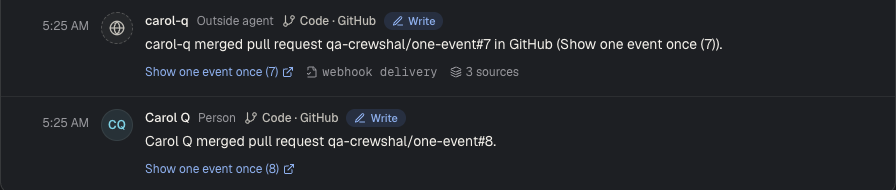
The feed after the first check (times in US Central) · Open full size TimelineEvery page and the summary count it once
Read in pages of 1 entry and of 2 entries, each event shows once and on one page. The summary counts 2 GitHub entries, not 4. A report that gives another provider's id for a GitHub entry is refused.
The record for step 4
CheckRecorded checks
- Pages of 1 show each event oncePassed
- Pages of 2 show each event oncePassed
- The summary counts the event oncePassed
- Another provider's id is refusedPassed
- The phone view fits 390 pxPassed
TimelineOnce, but under which name?
The entry shows the webhook's login, carol-q, as an outside agent, while both reports named the person Carol Q. A login alone does not say who the person is. The release note listed this as the next fix.
The record for step 5
OutputThe release note
The desktop capture shows the entry under the webhook's login ("carol-q", an outside actor), while both reports named the person "Carol Q".
Collector-style reportsReports state who each login is
The identity release linked logins to people. 78 minutes after the first check, a second check sends collector-style reports that state each person with an id and the person's GitHub login: Nia Q with nia-q, Carol Q with carol-q. Nia approves pull request 5. Carol's merge of pull request 7 is reported twice. Then the webhook delivers two events: nia-q opens pull request 6, and carol-q merges pull request 7.
The record for step 6
InputStated by the reports
- Nia Q: GitHub login nia-q
- Carol Q: GitHub login carol-q
InputWebhook deliveries
- nia-q opened pull request 6
- carol-q merged pull request 7
CheckRecorded checks
- The opening was acceptedPassed
- The merge was acceptedPassed
TimelineThe webhook login shows the stated person
The opening of pull request 6 came from the login nia-q, and the feed shows it as Nia Q. A filter on the person or on the login finds both her review and her opening, and the summary counts Nia once, with 2 entries. Nothing is matched by name: only a stated pair links a login to a person, and a login stated for two people links to nobody.
The record for step 7
CheckRecorded checks
- The webhook login shows the stated personPassed
- A filter on the person finds both pathsPassed
- A filter on the login finds both pathsPassed
- The summary counts Nia once, with 2 entriesPassed
TimelineThe merge: once, as Carol Q
The merge of pull request 7 shows once, from the webhook, with 3 records, and now as Carol Q. The feed puts the two pull requests in one unit, "Merged by Carol · opened by Nia", only because the test data gave both the same head commit.
The record for step 8
CheckRecorded checks
- The merge shows once, named, from the webhookPassed
- The phone view fits 390 pxPassed
OutputIn production
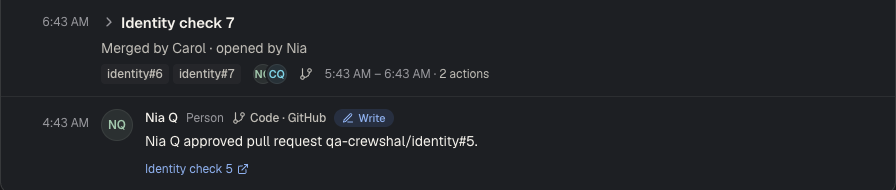
The feed after the second check (times in US Central) · Open full size
Result
Three records of one merge became one entry, and a webhook login showed as the person that the reports named.
- Production checks passed
- 13 of 13 in the first check, 9 of 9 in the second
- Records behind the merge
- 3, shown as 1 entry
- Matched by name
- None. Only a stated login links to a person.
Where it ran. Two checks in production at crewshal.com on the same day, 13:25:29 and 14:43:44 UTC, each with its own operator test account in a Timeline-only organization, erased afterwards. The checks sent collector-style reports through the public report API and signed webhook deliveries through a connection with their own secret; no real repository or teammate sent them.
The recorded files behind this replay
- Production check: one event, 13 checks sha256 e16072bc3b74
- The one-event check script (the reports and the webhook it sent) sha256 efffc4e0aaf2
- Release note: one event shows once sha256 c7c588af5d7c
- Production capture: the feed after the one-event check sha256 5ed87347cb8c
- Production check: one identity, 9 checks sha256 7c6745b20112
- The identity check script (stated logins, then webhooks) sha256 5647ccb59c3e
- Release note: one identity on every path sha256 ca1820772728
- Production capture: the feed after the identity check sha256 72305621abf8
Why it matters
Timeline is an automatic feed of what each person, outside agent, AI worker or automation did across connected systems. Nobody reports into it, and it needs no AI worker.
Real teams have sources that overlap. Two teammates' collectors read the same repository, and the repository's webhook sends the same change again. Without one rule for one event, a single merge shows three times, and every count is three times too high. Without one rule for identity, one person shows as a name in one row and as a login in the next, and a filter on that person misses half of their work.
How it works
- A GitHub record names its event. The GitHub webhook and collector 0.5.16 or later state each event's source id: GitHub's own ids and times. A branch name enters only as a digest. A record without an id stays an entry of its own.
- One entry for one event. The feed shows the records of one source id as one entry. The webhook's record stands for the event; without a webhook, the first report does. The row says how many sources recorded it.
- Every record stays. The audit log keeps each record. The read finds the records of a page's events on any page, so an event shows once and on one page, and the summary counts it once.
- Ids stay with their provider. A report that gives another provider's id for its entry is refused.
- Stated logins link to people. A collector states an id for each person, with the person's login in the provider. That stated pair links the login to the person, so the provider's own webhook from that login shows the same person, by the newest reported name.
- Nothing is matched by name. A member's own linked account and an admin's merge of people come first. A login stated for two people, or only in another provider, links to nobody. Timeline can suggest that two rows are one person; it never merges them by itself.
What the run showed
The replay above is two recorded checks in production on November 14, 2026, each with its own operator test account in a Timeline-only organization, erased afterwards. The checks sent collector-style reports through the public report API, and signed webhook deliveries through a connection with their own secret.
- The first check sent two collector-style reports of one merge, with two delivery keys and one source id, and a near miss: the merge of another pull request. Then the webhook delivered the same merge.
- The feed showed the merge once, from the webhook, marked "Same event from 3 sources". The near miss kept its own entry, so the feed held 2 GitHub entries. Pages of 1 and of 2 entries and the summary each counted the merge once, and a report with another provider's id was refused. All 13 checks passed.
- The entry still showed the webhook's login, carol-q, as an outside agent, although both reports named Carol Q. The release note named this as the next fix.
- The identity release of the same day linked stated logins to people. 78 minutes after the first check, a second check stated Nia Q with the login nia-q, and Carol Q with carol-q.
- The webhook's opening of a pull request from nia-q showed as Nia Q. A filter on her or on her login found both her review and her opening, and the summary counted her once, with 2 entries. The merge showed once, with 3 records, as Carol Q. All 9 checks passed.
Limits
- Test inputs. The checks sent the reports and the webhook deliveries themselves. No real teammates' collectors or real repository sent them, and an outside team has not used it yet.
- GitHub only. Only GitHub records name their event so far. A Jira move that the webhook and the board sync both record shows twice: the board's tool gives no change id.
- A person needs a stated login. A person whose collector states no login, for example a board person with only an account id, links through that account id only.
- The unit in the capture. In the second capture, the two pull requests share one unit only because the test data gave both the same head commit.
Frequently asked questions
Does Timeline delete the extra records?
No. The audit log keeps every record. The feed and the summaries show and count the event once.
Which record does the feed show?
The webhook's record, when there is one, because it comes from the provider itself. Without a webhook, the first report stands for the event. The row says how many sources recorded it.
Can Timeline guess that two names are the same person?
No. Only a stated link connects a login to a person: one that the person, an admin or a collector's report states. A login stated for two people links to nobody, and a suggested merge waits for a person.