Timeline warns when a source is late or read only part of its data
The idea
Source health is how Crewshal Timeline knows whether each source of activity is current. Every webhook, collector and token has a state that comes from recorded facts: current, late, stopped, never ran or no schedule. When a source is late, or its last read missed parts, the feed says that some activity may be missing.
- The problem
- A quiet feed could mean no work or a broken source.
- Why it matters
- Managers see which scheduled source is late or read only part of its data, so a quiet feed is not mistaken for a quiet team.
- Where it stands
- In production as of A real collector went from never ran to current, late and stopped in a production check.
Crewshal team · · 3 min read
Recorded run · Production, operator test account · November 14, 2026
Is every source current?
A real Timeline collector goes from paired to current, late and stopped, and the feed says when it might be missing activity.
Test accountA collector is paired
A test account installs the Timeline collector (version 0.5.17) from the served installer and pairs it. The collector has not run yet, so the source says Never ran. Nothing is guessed: there is no report yet.
CheckRecorded checks
- No source before pairingPassed
- A paired collector with no run is Never ranPassed
OutputSources
- Counts
- 1 Never ran
Test accountA collector is paired
A test account installs the Timeline collector (version 0.5.17) from the served installer and pairs it. The collector has not run yet, so the source says Never ran. Nothing is guessed: there is no report yet.
The record for step 1
CheckRecorded checks
- No source before pairingPassed
- A paired collector with no run is Never ranPassed
OutputSources
- Counts
- 1 Never ran
CollectorOne pass, and a due time
The collector reads one public repository and sends 34 new entries. Its report sets the next run for 18:36:52 UTC, 9 min 52 s later; the check had set a 5-minute interval for this run. The source is Current. The pass read only part of the repository, so the feed already warns that some activity may be missing.
The record for step 2
OutputThe collector's own line
sent: 34 new entries, 0 already there; 0 work items stored, 0 changed (1 calls).
OutputRun report
- Next run due
- 18:36:52 UTC, 9 min 52 s after the report
- Interval
- 5 minutes, set by the check for this run
- Last read
- Partial: missed 6 parts
OutputIn production

The feed, after the first pass · Open full size 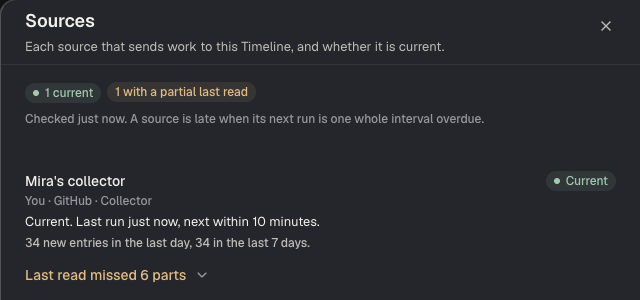
The Sources sheet · Open full size TimelineOverdue by a whole interval: Late
No run arrives: the check stopped the collector after its first pass. The server's own clock decides: the due time passed, then one more whole interval (5 minutes). At 18:42:37 UTC the source is Late, and the feed's warning now gives that reason.
The record for step 3
CheckRecorded checks
- A missed run plus one interval is LatePassed
- The feed says it is incomplete, with a sources gapPassed
DecisionWhy Late
- Run was due
- 18:36:52 UTC
- Checked
- 18:42:37 UTC, 5 min 45 s after the due time
OutputIn production

The feed · Open full size 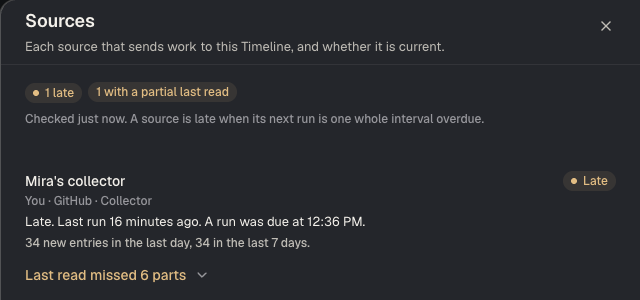
The Sources sheet (times in US Central) · Open full size Test accountSigned out: Stopped
The test account signs the collector out. The collector says that it stopped, so the source is Stopped, a recorded fact. The feed no longer counts it as a gap, although the 6 parts its first pass missed were never read.
The record for step 4
CheckRecorded checks
- Sign-out of the collectorPassed
- A disconnected collector is Stopped (it said so)Passed
- A stopped source is not counted as a gapPassed
- The person's own runner settings are unchangedPassed
OutputThe Sources sheet in production
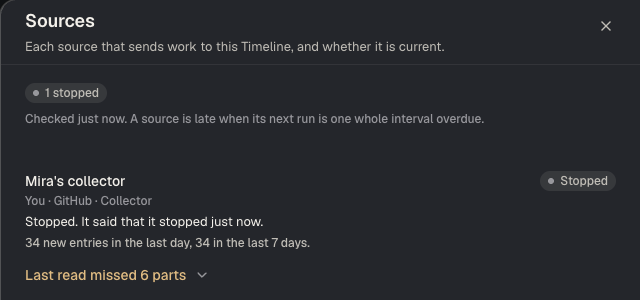
Stopped · Open full size
Result
The feed warned while its source had missed parts or was late, and stopped counting the source as a gap once it was signed out.
- Production checks passed
- 13 of 13
- Entries from the first pass
- 34
- States seen
- Never ran, Current, Late, Stopped
Where it ran. Production at crewshal.com with an operator test account (erased afterwards). A real collector (0.5.17) from the served installer read one public repository under a temporary home folder; the check set its interval to 5 minutes and stopped it after one pass. Webhook and API-token sources were proved by tests, not in this run.
The recorded files behind this replay
- Production check: states, times and 13 checks sha256 7f7b4ca8ef15
- Release note of the source states sha256 662b9d6c296f
- Production capture: the source is current sha256 5e1878b871d8
- Production capture: the source is late sha256 607f8f3ca4ea
- Production capture: the source is stopped sha256 89b79382bc64
- Production capture: the feed after the first pass sha256 b03d367d7b34
- The production check script (it set the interval for this run) sha256 5f6ec974a638
Why it matters
Timeline is an automatic feed of what each person, outside agent, AI worker or automation did across connected systems. Nobody reports into it, and it needs no AI worker.
That makes a quiet feed hard to read. It can mean that nobody worked, or that a source stopped sending. A manager who trusts a quiet feed can draw the wrong conclusion. Source health makes the difference visible for every source that runs on a schedule.
How it works
- Every run reports. Each collector pass sends a short run report, also when it found nothing or failed: whether its read was whole, which parts it missed, and when it will run next.
- The server decides the state. A source is current while its run reports keep arriving on time. It is late when its own announced next run, plus one whole interval, has passed without a run; the server's clock decides. It is stopped only by a recorded fact, for example a collector that says it stopped, a revoked or expired token, or a disabled webhook. Never ran and no schedule are states too.
- The feed marks itself. A late source, or a last read that missed parts, makes the feed show a warning with the reason. A stopped source does not, whatever its recorded reason.
- People see what they may see. Members see webhooks and their own sources, and only counts for other people's sources.
What the run showed
The replay above is a recorded check in production on November 14, 2026, on an operator test account that was erased afterwards.
- A real collector from the served installer was paired. Before its first run, its state was Never ran.
- One pass read a public repository and sent 34 new entries. Its report set the next run for 18:36:52 UTC, 9 minutes 52 seconds later; the check had set a 5-minute interval. The source was Current. The pass missed 6 parts of the repository, so the feed already showed "Some activity may be missing from this view."
- The check stopped the collector after its first pass, so no next run came. When the due time plus one whole interval had passed, the source was Late, and the feed's warning gave that reason: 1 source is late.
- The test account signed the collector out. The collector said that it stopped, and the source was Stopped. The feed no longer counted it as a gap, although the 6 parts that its first pass missed were never read.
- All 13 checks of the run passed.
Limits
- One kind of source in this run. Webhook and API-token sources were proved by tests, not in this run.
- Webhooks have no schedule. A webhook states no next run, so a webhook that goes quiet is never marked Late.
- Only the latest run is kept. The platform keeps the latest run of each source, not a history of runs.
- A state, not a repair. A late source tells you that activity may be missing. Someone still has to restart the collector.
Frequently asked questions
Does Timeline need an AI worker?
No. Timeline reads activity from the connected systems themselves. An organization can use it with no AI worker at all.
Who decides that a source is late?
The server's clock, measured against the next run that the source itself announced, plus one whole interval of grace. A source stays Current only while its run reports keep arriving on time.
Why does a stopped source not mark the feed?
A stopped source has a recorded reason to be silent: a sign-out, a revoked or expired token, a removed member or a disabled webhook. The feed does not count it as a gap, and the Sources sheet shows it as Stopped with the reason. Activity that it did not read before it stopped can still be missing.